US Supreme court Shakes the Foundations of Global trade
Many business groups welcomed the ruling and some expressed expectations that companies might be reimbursed for tariffs already paid. However, the court offered no indication as to whether refunds will be required.
The Outcomes US Supreme Courts Launched
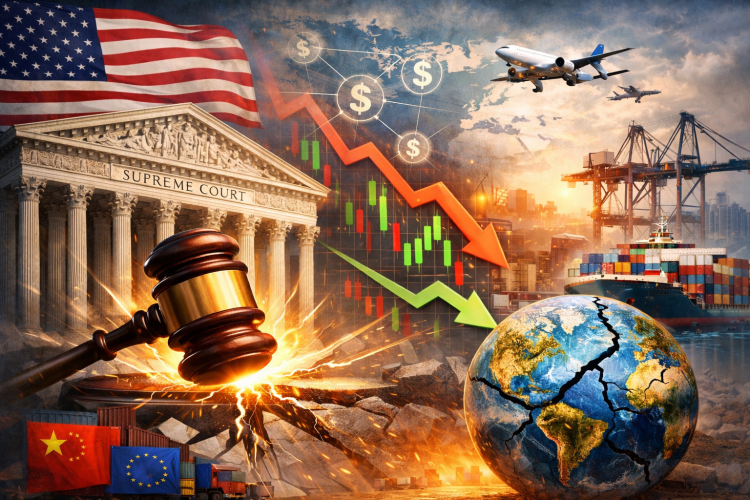
In a decision that could redefine the balance between law, politics, and economics, the Supreme Court of the United States has delivered a ruling with far-reaching consequences for global trade. What began as a domestic legal matter has now evolved into a development that may alter international supply chains, trade agreements, and investor confidence worldwide.
- For decades, the United States has played a central role in shaping global commerce. As the world’s largest economy and a leading trading nation, its legal and policy decisions often influence international markets. When the Supreme Court intervenes in matters affecting tariffs, executive trade powers, or regulatory authority, the ripple effects extend well beyond American borders.
- At the heart of the disruption lies the question of who holds the power to regulate trade. Traditionally, trade policy in the U.S. has been shaped by Congress, implemented by the executive branch, and guided by international agreements under institutions like the World Trade Organization. However, recent judicial scrutiny has challenged the scope of executive authority in imposing tariffs and trade restrictions, potentially redefining the balance of power.
➡️Such legal reinterpretations create uncertainty in global markets. Businesses rely heavily on predictable trade rules when making investment decisions. If tariffs can be limited, reversed, or subjected to new legal standards, multinational corporations must reassess their strategies. Supply chains—already strained by geopolitical tensions and post-pandemic recovery—may face further complications.
➡️Financial markets reacted cautiously to the ruling. Investors fear that prolonged legal battles could slow down trade negotiations or disrupt existing agreements. Countries that depend on exports to the U.S. may also face uncertainty regarding tariff structures and regulatory requirements. This uncertainty can weaken investor sentiment, impact currency values, and reduce cross-border investment flows.
➡️The decision also carries political implications. Trade has long been a tool of foreign policy. If judicial limits constrain executive trade actions, future administrations may find it harder to use tariffs as leverage in negotiations. On the other hand, stronger judicial oversight could promote transparency and adherence to constitutional principles, reinforcing the rule of law.
➡️From a global perspective, this ruling may encourage other nations to re-examine their own trade governance frameworks. International partners are closely watching how the United States adapts to this shift. Any significant policy recalibration could influence global trade agreements, regional partnerships, and economic alliances.
➡️While some experts argue that judicial intervention strengthens institutional checks and balances, others warn that it may slow decision-making during economic crises. The long-term impact will depend on how policymakers respond—whether through legislative reform, diplomatic engagement, or strategic economic adjustments.
In conclusion,
The Supreme Court’s ruling is more than a domestic legal event; it is a development with global economic consequences. By potentially redefining the boundaries of trade authority, the Court has introduced a new layer of complexity into the international trade regime. Whether this shift leads to greater stability or prolonged uncertainty remains to be seen, but one thing is certain: global trade will not remain untouched.
Files
What's Your Reaction?